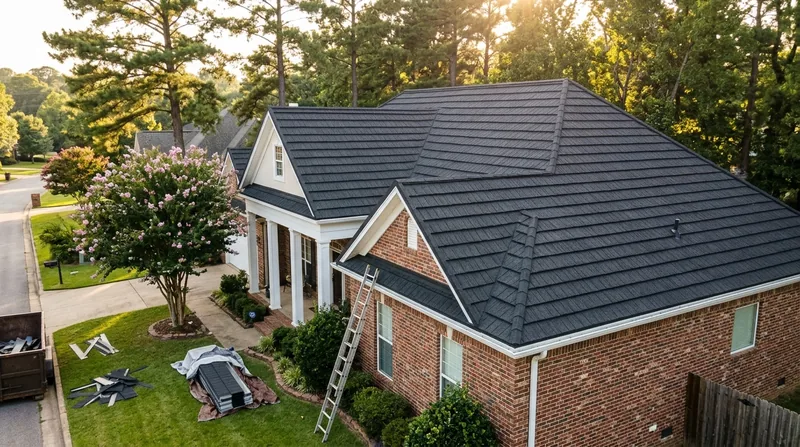




Little Rock sits where the Ouachita foothills meet the Delta, and the roof over your head takes a beating from both sides. Spring supercells roll up the Arkansas River valley with large hail and straight-line winds. Summer humidity feeds algae streaks on north-facing slopes from Hillcrest to Chenal Valley. Winter freeze-thaw cycles work on every fastener and flashing detail. Stone-Coated Steel Roofing in Little Rock answers all of it with a steel core under a textured granule finish that reads like shake, slate, or tile from the curb. We install systems rated for the hail and wind this county actually gets, on 1910s Craftsman bungalows in the Heights and 2010s brick two-stories in Bryant alike. If you are weighing profiles, start with our metal roof installation overview and then come back to this page.
Why Stone-Coated Steel Holds Up to Pulaski County Weather
Shingle roofs in Riverdale, Sherwood, and North Little Rock take a hail hit and lose granules, then leak at the same valleys and penetrations year after year. Stone-coated steel puts a galvanized steel panel underneath the stone, so the impact that punches through asphalt only scuffs the surface. The textured finish also hides the dents that bare metal panels show after a hailstorm.
- We set the system up to shed the heavy spring rain that backs up behind chimneys and in valleys.
- We choose fire-rated assemblies where the property sits near the pine stands around Pinnacle Mountain.
- We match profiles to the house: shake-look panels on Hillcrest bungalows, tile-look panels on Mediterranean elevations in Chenal Valley.
- We leave the algae-resistant granule finish intact so north slopes stay clean through humid summers.
That combination of impact resistance and traditional looks is why stone-coated steel keeps showing up on replacement jobs across West Little Rock and Maumelle.
Key info: A 2019 hail event tracked across Pulaski County and pounded shingle roofs in Bryant and Benton while stone-coated steel panels on the same streets came through with surface scuffs only. The panels stayed watertight and the granule finish kept the color.
Roofing permits are commonly required for a full replacement or re-roof in Little Rock, and thresholds vary by jurisdiction. Confirm current rules with the City of Little Rock building department before work starts.
How We Install Stone-Coated Steel on a Little Rock Roof
Stone-coated steel is not a nail-it-and-go panel. The underlayment, the battens, and the flashing details decide whether the roof performs for 40 years or fails at the first ice storm. We work the sequence the same way on a steep Quapaw Quarter gable and on a low-slope ranch in Jacksonville.
- We tear off the existing shingles down to the deck and inspect for soft spots, because a stone-coated system needs a flat, sound substrate.
- We install a high-temperature synthetic underlayment and, where the profile calls for it, a batten grid that lets the panels drain and breathe.
- We set the starter course, then lay panels in the manufacturer's pattern so the stone texture lines up across the field.
- We flash chimneys, skylights, and sidewalls with metal that matches the panel, not caulk and hope.
- We fasten to the manufacturer's wind-uplift spec for the exposure, then walk the roof and check every lap and penetration.
Every job ends with a magnet sweep of the yard and gutters, because the pines and oaks around here will find any stray screw.
Key info: On a 1920s Craftsman in Hillcrest, the original skip sheathing had gaps too wide for a stone-coated panel to bridge. We laid a solid deck over it, then ran the new system. The homeowner kept the shake look and gained a roof that handles hail.
If your current roof is still sound enough for a retrofit, our metal roof over shingles page explains when a recover is allowed and when a full tear-off is the only code-compliant path.
Stone-Coated Steel Approaches We Use in Little Rock
Not every Little Rock roof wants the same panel. A steep Victorian gable in the Quapaw Quarter, a low-pitch ranch in Sherwood, and a subdivision two-story in Cabot each call for a different profile and fastening method. The table below lays out the approaches we install most.
| Approach | Description | Best for |
|---|---|---|
| Shake-profile stone-coated panels | Textured panels that mimic cedar shake with a steel core underneath. | Craftsman bungalows in Hillcrest and the Heights. |
| Tile-profile stone-coated panels | Interlocking panels with a barrel or flat-tile look and concealed fasteners. | Mediterranean and Spanish elevations in Chenal Valley. |
| Slate-profile stone-coated panels | Dimensional panels that read as slate at a fraction of the weight. | Colonial Revivals and Tudor homes in Pulaski Heights. |
| Low-slope stone-coated system | Panels rated for lower pitches with a sealed underlayment and wider laps. | 1950s-70s ranches and split-levels in Riverdale and Jacksonville. |
| Class A fire-rated assembly | A system built to the highest fire rating with noncombustible components. | Homes backing up to the pine stands near Pinnacle Mountain. |
We pick the approach after we see the pitch, the deck, and the exposure, not before.
Stone-Coated Steel Roofing Cost in Little Rock: What to Expect
Stone-coated steel pricing in Little Rock starts around $9 per square foot installed, and that figure moves with the roof. A simple gable on a Bryant subdivision house lands near the bottom. A steep, cut-up Victorian in the Quapaw Quarter with three chimneys and a turret pushes toward the top. The panel profile, the tear-off, and the flashing detail all pull on the number.
Access matters as much as square footage. A roof hemmed in by mature oaks in the Heights takes longer to load and protect than an open lot in Cabot. Deck repairs, fascia replacement, and any hidden rot show up once the shingles come off, so we price those separately and show you photos before we touch them. Getting two or three written estimates is the smart move, and each one should spell out the panel, the underlayment, the flashing, and the disposal. Our full pricing overview breaks down the line items so you can compare bids apples to apples.
Stone-Coated Steel Roofing Near Me: How to Vet a Contractor Near Little Rock
Hiring a roofer near Little Rock comes down to paperwork and proof. Call two references from jobs in Pulaski County and ask how the roof has held up through a hail season. Check that the contractor pulls the permit in their name and knows which neighborhoods sit inside historic review, because the Quapaw Quarter and parts of MacArthur Park restrict panel profile and color.
HOA design review in Chenal Valley, Maumelle, and Bryant can also limit what you install, so get written approval before you order panels. A contractor who shrugs at that step will cost you later. When you are ready to compare numbers, reach out through our contact page and we will walk the roof with you.
Stone-Coated Steel Roofing in Little Rock: Pricing Guide
| Service | Price | Details |
|---|---|---|
| Stone-coated steel, standard gable | Starting at $9/sq ft | Includes tear-off, synthetic underlayment, panels, and standard flashing on an accessible roof. |
| Stone-coated steel, steep or cut-up roof | Starting at $12/sq ft | Covers extra labor for steep pitch, multiple valleys, and chimney or skylight detailing. |
| Retrofit over existing shingles | On estimate | Depends on existing layer count, deck condition, and whether local code allows a recover. |
| Complex or historic home | On estimate | Needs an on-site look for deck repairs, profile restrictions, and historic district review requirements. |
| Travel | Included | In Little Rock and surrounding areas, no separate call-out or mileage fee. |
| Estimate | Free | Response within 24h at (501) 476-2705, no obligation to book. |
Indicative pricing, the exact cost depends on square footage, finish, and site access. Free personalized estimate within 24h at (501) 476-2705.


