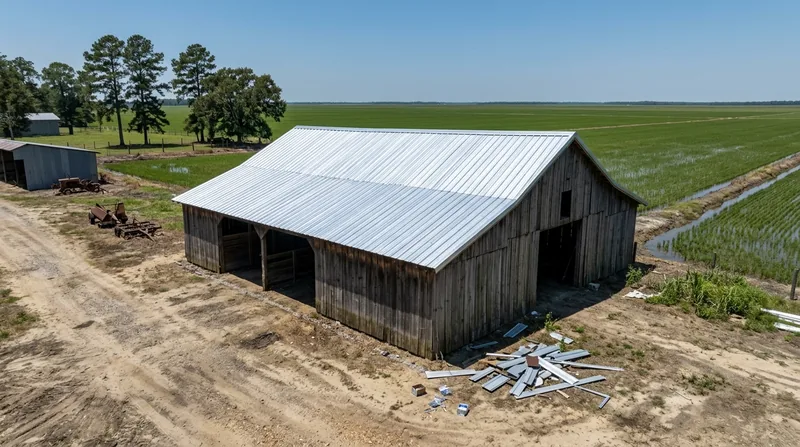




Commercial & Agricultural Metal Roofing in Little Rock: Built for Barns, Shops and Light Commercial Buildings
Little Rock sits where the Ouachita foothills meet the Delta, with Pinnacle Mountain on the western skyline and the Arkansas River cutting through the middle of Pulaski County. That mix of rocky clay, sandy loam and open river-bottom ground is why so many barns, workshops, churches, carports and light commercial buildings across central Arkansas still run on exposed-fastener metal. If you own one of those buildings, Commercial & Agricultural Metal Roofing in Little Rock is the work we do most weeks, from Lonoke and Faulkner County farm buildings to North Little Rock and Conway shops. The sun, the spring supercells and the occasional ice storm all push on the same roof, and a leak over a hay loft or a parts counter gets expensive fast. We install, repair and replace panel systems with the insulation and flashing details that keep a working building dry. See the full scope on our metal roof installation page.
Why Commercial and Agricultural Metal Roofing Matters Across Pulaski County
Central Arkansas puts two very different demands on a metal roof. A hay barn off Highway 70 near Lonoke takes full sun and wind with no shade, while a shop in North Little Rock or a church hall in Conway deals with loblolly pine needles, oak limbs and sweetgum balls dropping on the panels every season. The dominant failure mode in this city is not salt or fog, it is fastener back-out and washer rot on exposed-fastener panels after years of heat cycling, followed by wind-driven rain pushing under lifted laps. Add the algae and mildew that hot humid summers feed on the north slopes, and an unmaintained ag panel starts streaking and leaking in year eight to twelve.
- Large hail from spring supercells dents and stretches thin panel gauges, which loosens the seal around each screw.
- Wind uplift peels back ridge caps and end laps on barns and shops that sit exposed on open Delta ground.
- Pine needles and leaf litter trap moisture in the pans and rot the washer heads from the top down.
- Ice storms glaze the panels and load the gutters, and freeze-thaw cycles work screws loose over winter.
- Old, thin 29-gauge panels on 1970s and 1980s farm buildings simply reach the end of their service life.
Every one of those problems has a fix that costs far less than replacing the whole building envelope, provided you catch it before the deck or the framing is wet.
Key info: A 40x60 shop in Sherwood with 1980s 29-gauge ribbed panel is a typical call. We usually find a dozen backed-out screws along the windward eave and two lifted end laps. Re-fastening with longer screws and new EPDM washers plus fresh butyl tape on the laps buys years of service for a fraction of a re-roof.
Before you spend on a new roof, check the local rules. Roofing permits are commonly required for a full replacement or re-roof, and thresholds and inspection requirements vary by jurisdiction, so confirm with the City of Little Rock building department and your county before work starts.
How We Roof a Barn, Shop or Church Building in Little Rock
Commercial and agricultural roofs are working surfaces, so we plan the job around access and around whatever the building does during the day. A church hall in Jacksonville cannot lose its roof over a Sunday, and a parts shop in North Little Rock needs the lot clear by Monday morning. We walk the building, measure the panel runs, check the purlins and the existing insulation, and stage material where a truck and a lift can reach it without tearing up the yard. On farm buildings out toward Lonoke and Mayflower, that often means a field gate and a plan for soft ground after rain.
- We inspect the deck, purlins, fasteners and flashing and photograph every problem area.
- We measure panel runs and confirm the profile, gauge and color against what the building already has.
- We remove the old panels and haul them off, or plan a retrofit over the existing roof where code allows.
- We install new underlayment, insulation and closure strips before the first panel goes down.
- We set panels square to the eave, fasten to the purlins and seal every penetration and transition.
- We walk the roof, water-test the flashings and clean the gutters before we call the job done.
The same crew handles the repair side, so a loose ridge cap or a leaking vent boot does not turn into a full replacement quote.
Key info: A Faulkner County hay barn near Mayflower had pine needles packed two inches deep in the pans and a leaking ridge. We cleared the debris, replaced the ridge cap and re-fastened the windward slope with new screws and washers. The owner kept the original panels and avoided a full re-roof that season. For panel-specific work, see our corrugated and ribbed panel roofing page.
Panel Systems We Install on Central Arkansas Commercial and Ag Buildings
Not every building needs the same panel. A hay barn wants cheap, wide coverage and good ventilation. A light commercial building in Conway or a church in Benton wants a tighter profile, better insulation and a color that holds up under Arkansas sun. We match the system to the building and to the budget, and we tell you plainly when a repair is the smarter call.
| Approach | Description | Best for |
|---|---|---|
| Exposed-fastener ribbed panel | Screw-down 26 or 29 gauge panels with EPDM washers, fast and economical over open framing. | Barns, sheds, carports and workshops |
| Standing seam | Concealed-fastener panels with raised seams, no exposed screws to back out. | Churches, retail and light commercial |
| Insulated panel system | Panel over rigid insulation and underlayment to cut heat and condensation. | Shops and climate-sensitive buildings |
| Retrofit over existing metal | New panels and underlayment over sound existing framing where code allows. | Older barns and outbuildings |
| Repair and re-fastening | Screw replacement, new washers, lap sealant and flashing repair on sound panels. | Leaks and wind-lifted sections |
If you are unsure which system fits, a walk of the building settles it faster than any phone description.
Commercial & Agricultural Metal Roofing Cost in Little Rock: What to Expect
We start every job with a free estimate, because a number given over the phone on a 60x100 barn is a guess. Cost moves with the square footage, the panel gauge and profile, how much old material has to come off, and how hard the building is to reach. A shop with a clear drive and a lift-friendly eave prices differently from a barn down a soft field road near Lonoke. Insulation, skylights, ridge vents and gutter work add to the total, and so does any deck or purlin repair we find once the panels are off.
- Panel gauge and profile set the base material cost, with 26 gauge running above 29 gauge.
- Roof pitch and height drive labor, and steep or tall buildings take more time and more safety setup.
- Tear-off and disposal of old panels and underlayment add a line item on most replacements.
- Insulation, vents and skylights raise the total but pay back in comfort and condensation control.
- Access matters, and a building with a clear approach and firm ground prices lower than one reached through a gate and across a wet field.
Get two or three estimates on the same scope so you are comparing the same panel, the same underlayment and the same flashing detail, not three different jobs. Our full pricing overview breaks down what each line covers.
Commercial & Agricultural Metal Roofing Near Me: How to Pick a Contractor Around Little Rock
Plenty of crews will quote a barn roof. Fewer will show you a license, a certificate of insurance and a reference on a building like yours. Ask for all three before anyone climbs a ladder, and ask whether the crew carries fall protection for the height involved. On agricultural buildings, a fall from a barn roof is the most common serious injury on the job, so safety setup is part of the price, not an extra.
- Confirm the contractor is licensed and insured, and ask for the certificate to be sent to you directly.
- Get two or three written estimates on identical scope so the comparison is fair.
- Ask for references on commercial or agricultural buildings within driving distance of Little Rock.
- Check who pulls the permit, since roofing permits are commonly required and rules vary by jurisdiction.
- Ask about historic district or HOA design review if the building sits in a protected area or a managed property.
If a quote is far below the others, ask what is missing from it, because something usually is. Reach us through the contact page and we will walk your building and put the scope in writing.
Commercial & Agricultural Metal Roofing in Little Rock: Pricing Guide
| Service | Price | Details |
|---|---|---|
| Panel repair and re-fastening | Free estimate | Covers screw replacement, new washers and lap sealant on sound panels, priced by roof size and access. |
| Exposed-fastener panel re-roof | Starting at $3.50 per sq ft | Includes tear-off, underlayment and 29-gauge ribbed panel, with gauge and pitch moving the price. |
| Standing seam on light commercial | Starting at $9 per sq ft | Concealed-fastener panels, underlayment and trim, with building height and insulation adding cost. |
| Complex or large-scale building | On estimate | Barns, churches and shops over 5,000 sq ft need an on-site look at framing, access and staging. |
| Travel | Included | In Little Rock and surrounding central Arkansas towns, with no separate call-out or mileage fee. |
| Estimate | Free | Response within 24 hours at (501) 476-2705, with no obligation to book the work. |
Indicative pricing, the exact cost depends on square footage, finish, and site access. Free personalized estimate within 24h at (501) 476-2705.


